

New Jerusalem
The world premiere of Octavia. Trepanation will take place on June 15 as part of the Holland Festival. It is composed by Dmitri Kourliandski and directed by Boris Yukhananov, the artistic director of Moscow’s Stanislavsky Electrotheatre.
Constant Meijers, the author of this article, stunned by Yukhananov’s production of The Tale of an Upright Man 12 years ago, already knew the director. Recently he met with him again in Moscow.
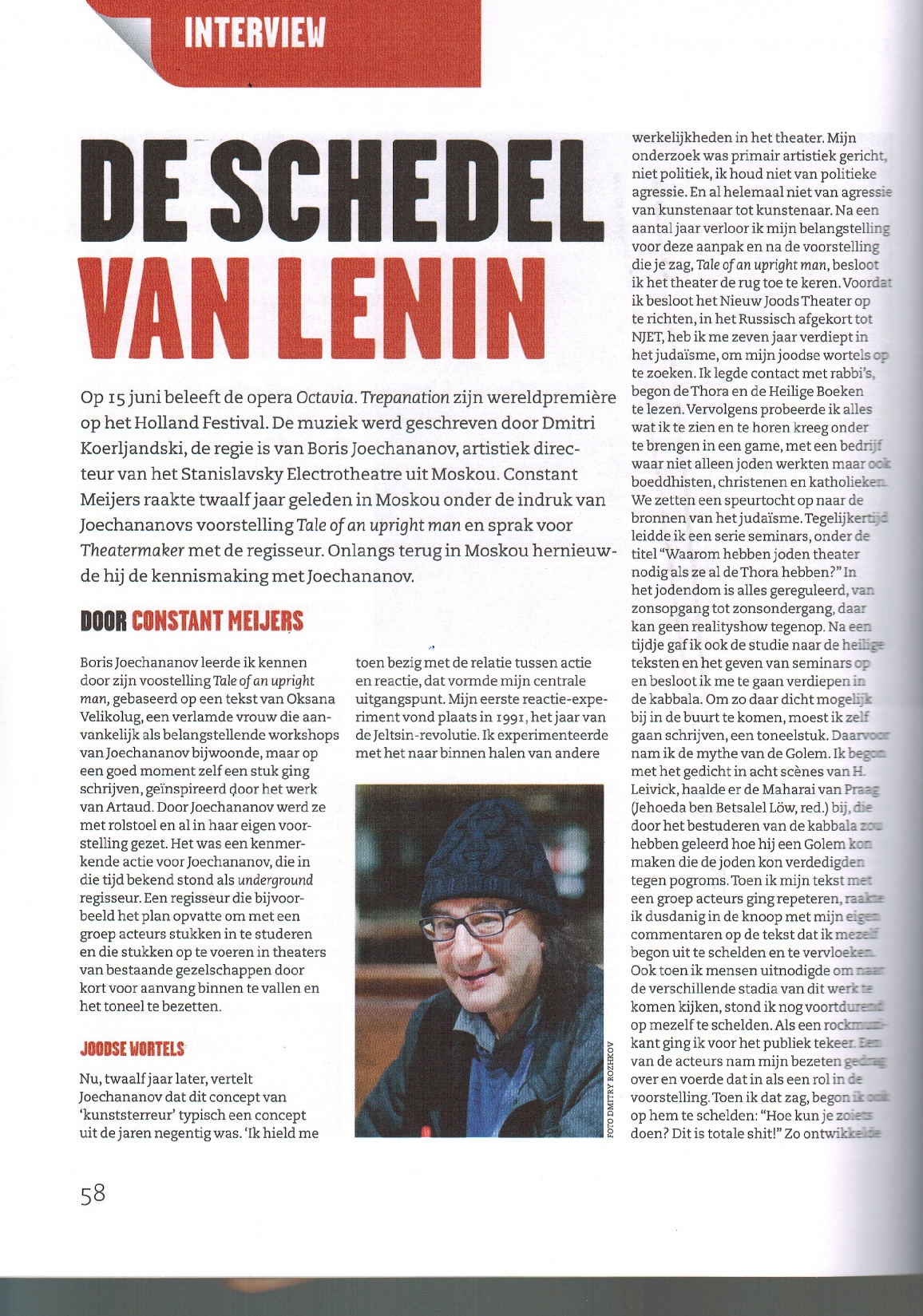
I made the acquaintance of Boris Yukhananov after seeing his The Tale of an Upright Man, a production based, in part, on a text by Oksana Velikolug, a young, paralyzed woman who was a student of Yukhananov’s workshop, and who, under the influence of Artaud, herself wrote a play. Thanks to Yukhananov, this woman in a wheelchair found herself on stage in the middle of her own performance. Yukhananov, who was a well-known figure in the theatrical underground of the time, was famed for such acts. For example, he once planned to perform his own productions on various other theatres’ stages by having his actors rush stages and take them over shortly before planned performances were to begin.
Jewish Roots
Today, 12 years later, Yukhananov says this conception of “art-terrorism” was characteristic of the 1990s.
“I was then fascinated by the connection between action and reaction. This connection was a starting point for my work. My first experiment of this kind took place in 1991, the year of the Yeltsin revolution. I experimented in theater with other realities. My research was mainly an artistic, not a political, vector. I don’t support political aggression. To say nothing of artistic aggression by one artist against another. A few years later, I lost interest in this approach and, after the production you saw, The Tale of an Upright Man, I decided to quit theatre. Before resolving to found the New Jewish Theater (NET in Russian), I immersed myself in Judaism for seven years in order to discover my Jewish roots. I communicated with rabbis, I read the Torah and other sacred texts. Then I tried to turn everything I had seen and heard into performance, working with people who were not only Jews, but Buddhists, Christians and Catholics. We set out in search of the origins of Judaism. At the same time, I conducted a series of seminars entitled ‘Why do Jews need theater if they have the Torah?’ The lives of Jews are completely regulated, from sunrise to sunset; no reality show could possibly compete with this. After awhile, I left the study of the sacred texts and seminars and turned to the Kabbalah. To better experience this teaching, I decided to write a play based on the myth of the Golem. I started with the poem by H. Leivick in eight scenes, I introduced the Maharal from Prague, who, according to legend, knew the secrets of the Kabbalah and created the Golem, which was capable of protecting Jews from pogroms. When a group of actors began rehearsing my text, I got completely mixed up in my own comments and began to curse myself. Even when I invited audiences to view performances at various stages of the work, I constantly scolded everyone. I raged at the public like a rock musician. One of the actors took on my insane behavior and introduced him as a character in the play. When I saw this, I exploded at him: ‘What are you doing? This is complete shit!’ But for three years the performance developed almost under its own power. There were a variety of reviews, positive and negative. In the framework of our publishing project ‘Theater and its Diary,’ wherein we publish diaries of major directors, I present an eight-volume edition that includes the textual records of the play Golem, photographs and video recordings that recorded the process of its creation. The presentation of this project will be held May 28. It’s essentially dedicated to the New Jewish Theatre.”
Director’s Theatre
After Golem, Yukhananov chose to return to the theatre. He mounted a Faust project then staged The Constant Principle, which collated Calderon's story of the Portuguese holy Prince Fernando, The Constant Prince, and Pushkin’s Feast in a Time of Plague. This production is about the war between Islam and Christianity.
"Then I started working with my Studio for Individual Directing (MIR-4) on several major projects, including The Golden Ass project. I was inspired by Lewis Hyde's book Trickster Makes This World. Trickster is the hero of our time, and the oldest book on this subject is Apuleius' book The Golden Ass. In this way, I managed to connect the Greeks, the Kabbalah and Judaism."
When the Moscow city government announced a competition for the post of head of the Stanislavsky Drama Theater, Yukhananov resolved to participate.
“I wrote a long letter, in which I described in detail how I imagined a new theatre should look: a director’s theatre, a theatre that is open to the whole world. I won the competition, established a fund with the help of a friend, a successful businessman, and we embarked on the complete reconstruction of the theatre. Many Russian theatres use funds, because government subsidies alone are not sufficient to do the work. We created a multifunctional main stage, in which any form of theater is possible. Then we added a small stage. My plan is to invite European directors representing different generations to the theater. We have already collaborated with Theodoros Terzopoulos, Romeo Castelluci and Heiner Goebbels. When I crossed the threshold of the old theater I had a feeling I had entered a cage of wild animals. Then a great communicative process began - I called it ‘communicative homeopathy.’ I talked to everyone separately, with every one of the 250 people working in the theatre, to tell them about my plans and listen to their wishes. All of them were devoted enthusiastically to the work of the theatre. In the course of three years, I have been able to implement several large projects and turn the theater into one of the most advanced in the country.”
Three Empires
The idea of a new opera Octavia. Trepanation dates back to 1989, when Yukhananov inhabited the world of the Russian underground, living and working in the cellars of Moscow apartment buildings.
“I came across a text about Octavia, which is attributed to Seneca and in which Nero kills his mother, abandons his wife and sets fire to Rome. Then I took Trotsky's long essay on Lenin and I combined both texts. Trotsky described Lenin as a genius, but a genius with a monstrous mission that gave rise to tyranny. Trotsky had an ambivalent attitude toward Lenin, which did not prevent him from paying tribute to the genius of Lenin. Intuitively, I linked the story of Nero to the future collapse of the Soviet empire, which occurred between 1990 and 1992. This is exactly what this show was about. Now, thirty years later, it is a completely different work. I wrote a libretto with the composer Dmitri Kourliandski, and Dmitri wrote the music.
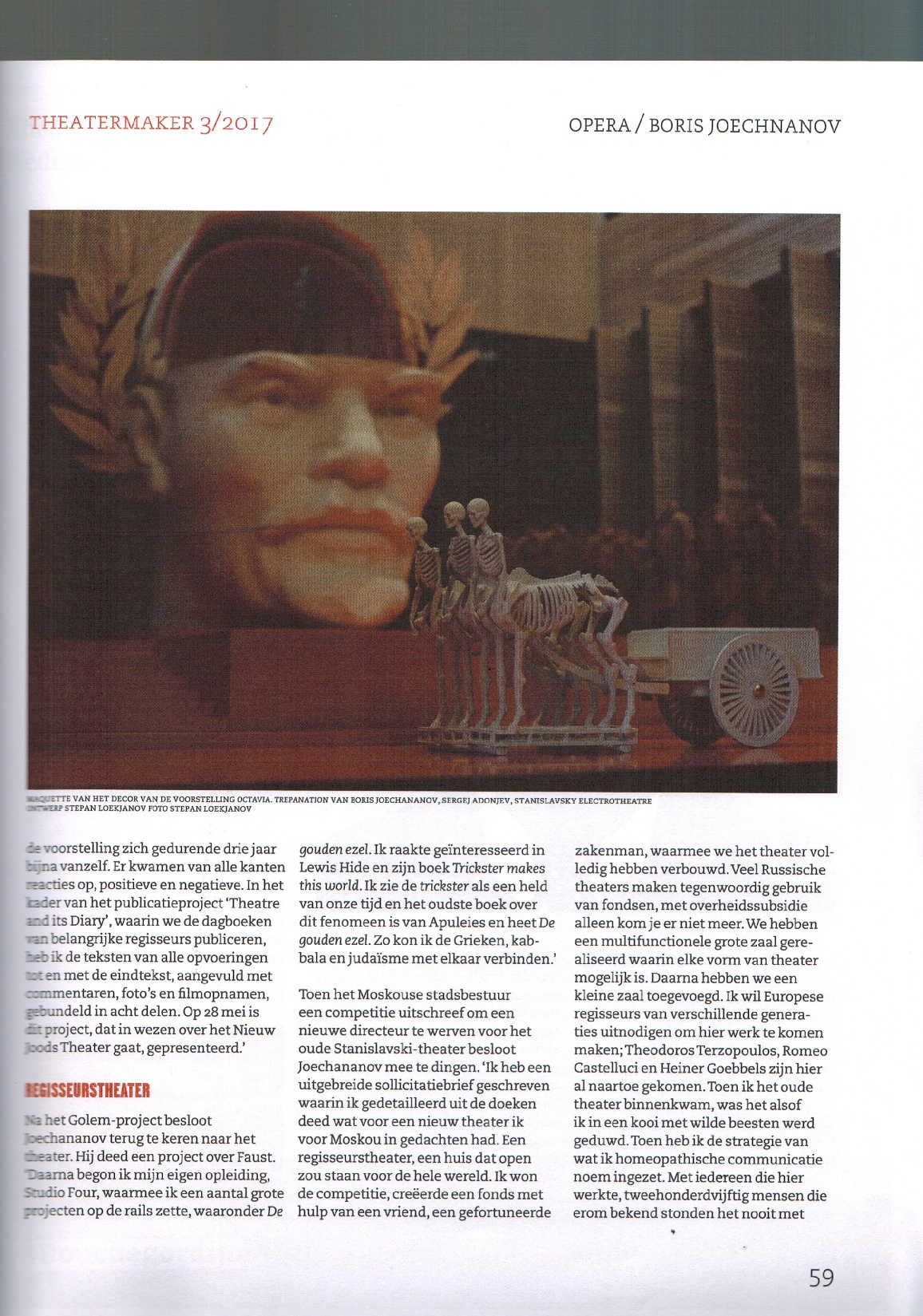
“The new production speaks of revolution as a form of tyranny. In it we unite three empires: the Roman empire of Nero, the Soviet Union of Lenin, and the Chinese empire of the times of the terracotta armies. The giant head of Lenin, in a laurel wreath like a Roman emperor, looms large on stage. Trepanation refers to the fact that in 1922 Lenin was subjected to a trepanation of the skull during the autopsy to find out what he died of. There were suspicions that he died from the effects of syphilis. It turned out not so - he died of a stroke. We show this by opening his skull. The head of Lenin is designed in the form of a three-story house, with various technical tricks inside. To the right and left of the head stand soldiers of the terracotta army, each measuring 2 meters 30 cm in height. The singers of the opera chorus are located inside the headless soldiers.
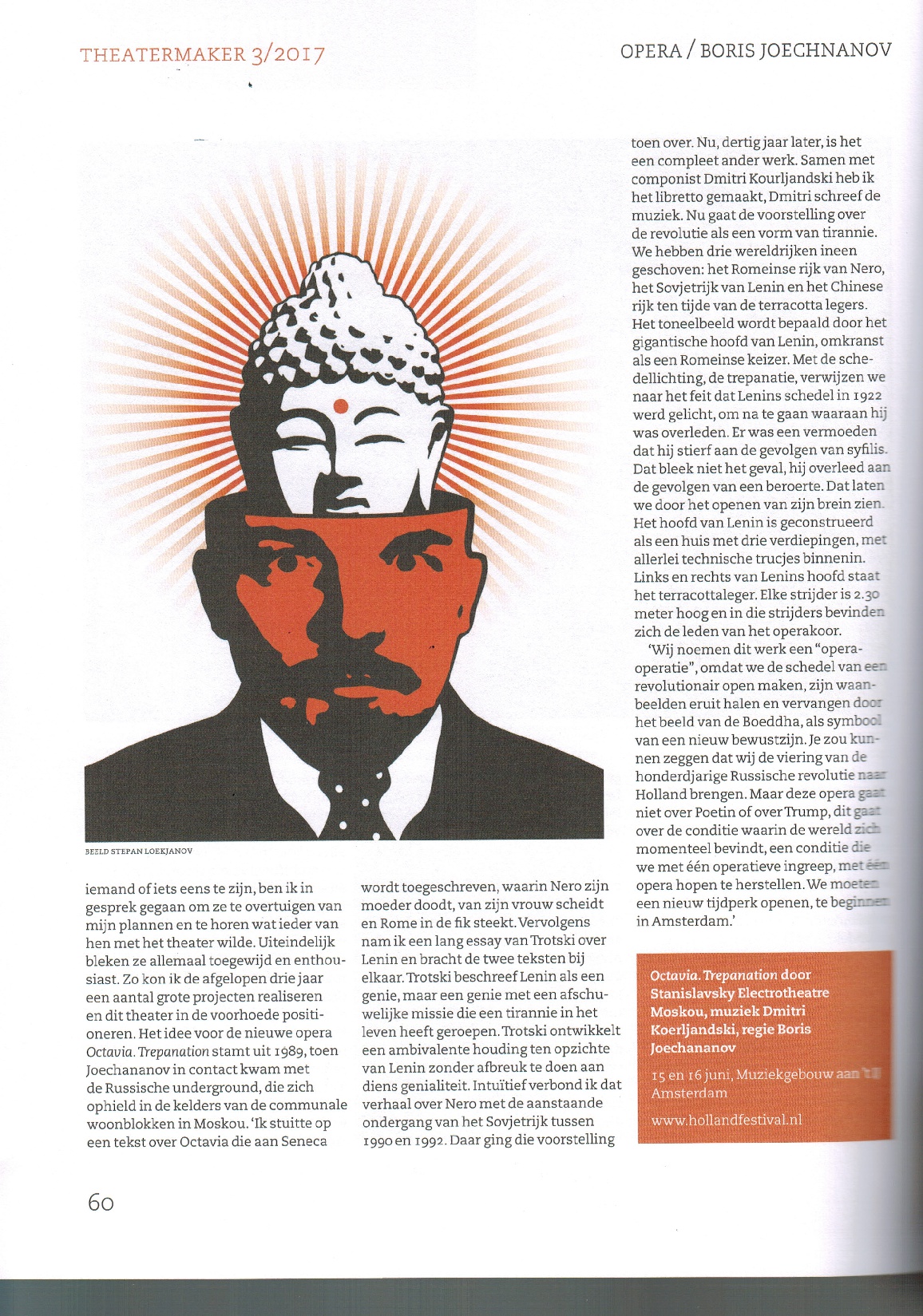
“We call this work an ‘opera operation,’ because we open the skull of a revolutionary, eliminate his illusions and replace them with a statue of Buddha symbolizing a new consciousness. We can say that in this way we will celebrate the centenary of the Russian revolution in Holland. This opera is not about Putin or Trump, however. It is about the state of our world today, a situation that we hope to improve with one intervention, with the aid of one opera. We must initiate a new era that will begin in Amsterdam.”
[Information about the production]
Octavia. Trepanation. Stanislavsky Electrotheatre, composer: Dmitri Kourliandski, director: Boris Yukhananov
June 15 and 16, Muziekgebouw, Amsterdam
www.hollandfestival.nl
______________________________________________________________________________________________________________________
Theatermaker
Artikel: Boris Joechananov (dit is de spelling die het HF gebruikt)
Auteur: Constant Meijers
Aantal woorden: 1475
Een nieuw Jeruzalem
Op 15 juni beleeft de opera Octavia. Trepanation zijn wereldpremière op het Holland Festival. De muziek werd geschreven door Dmitri Koerljandski, de regie is van Boris Joechananov, artistiek directeur van het Stanislavsky Electrotheatre uit Moskou. Constant Meijers raakte twaalf jaar geleden in Moskou onder de indruk van Joechananovs voorstelling Tale from an upright man en sprak voor Theatermaker met de regisseur. Onlangs terug in Moskou hernieuwde hij de kennismaking met Joechananov.
Door Constant Meijers
Boris Joechananov leerde ik kennen door zijn voostelling Tale from an upright man, gebaseerd op een tekst van Oksana Velikolug, een verlamde vrouw die aanvankelijk als belangstellende workshops van Joechananov bijwoonde, maar op een goed moment zelf een stuk ging schrijven, geïnspireerd door het werk van Artaud. Door Joechananov werd ze met rolstoel en al in haar eigen voorstelling gezet. Het was een kenmerkende actie voor Joechananov, die in die tijd bekend stond als underground regisseur. Een regisseur die bijvoorbeeld het plan opvatte om met een groep acteurs stukken in te studeren en die stukken op te voeren in theaters van bestaande gezelschappen door kort voor aanvang binnen te vallen en het toneel te bezetten.
Joodse wortels
Nu, twaalf jaar later, vertelt Joechananov dat dit concept van ‘kunststerreur’ typisch een concept uit de jaren negentig was. ‘Ik hield me toen bezig met de relatie tussen actie en reactie, dat vormde mijn centrale uitgangspunt. Mijn eerste reactie-experiment vond plaats in 1991, het jaar van de Jeltsin-revolutie. Ik experimenteerde met het naar binnen halen van andere werkelijkheden in het theater. Mijn onderzoek was primair artistiek gericht, niet politiek, ik houd niet van politieke agressie. En al helemaal niet van agressie van kunstenaar tot kunstenaar. Na een aantal jaar verloor ik mijn belangstelling voor deze aanpak en na de voorstelling die je zag, Tale of an upright man, besloot ik het theater de rug toe te keren. Voordat ik besloot het Nieuw Joods Theater op te richten, in het Russisch afgekort tot NJET, heb ik me zeven jaar verdiept in het judaïsme, om mijn joodse wortels op te zoeken. Ik legde contact met rabbi’s, begon de Thora en de Heilige Boeken te lezen. Vervolgens probeerde ik alles wat ik te zien en te horen kreeg onder te brengen in een game, met een bedrijf waar niet alleen joden werkten maar ook boeddhisten, christenen en katholieken. We zetten een speurtocht op naar de bronnen van het judaïsme. Tegelijkertijd leidde ik een serie seminars, onder de titel “Waarom hebben joden theater nodig als ze al de Thora hebben?” In het jodendom is alles gereguleerd, van zonsopgang tot zonsondergang, daar kan geen realityshow tegenop. Na een tijdje gaf ik ook de studie naar de heilige teksten en het geven van seminars op en besloot ik me te gaan verdiepen in de kabbala. Om zo daar dicht mogelijk bij in de buurt te komen, moest ik zelf gaan schrijven, een toneelstuk. Daarvoor nam ik de mythe van de Golem. Ik begon met het gedicht in acht scènes van H. Leivick, haalde er de Maharai van Praag (Jehoeda ben Betsalel Löw, red.) bij, die door het bestuderen van de kabbala zou hebben geleerd hoe hij een Golem kon maken die de joden kon verdedigden tegen pogroms. Toen ik mijn tekst met een groep acteurs ging repeteren, raakte ik dusdanig in de knoop met mijn eigen commentaren op de tekst, dat ik mezelf begon uit te schelden en te vervloeken. Ook toen ik mensen uitnodigde om naar de verschillende stadia van dit werk te komen kijken, stond ik nog voortdurend op mezelf te schelden. Als een rockmuzikant ging ik voor het publiek tekeer. Een van de acteurs nam mijn bezeten gedrag over en voerde dat in als een rol in de voorstelling. Toen ik dat zag, begon ik ook op hem te schelden: “Hoe kun je zoiets doen? Dit is totale shit!” Zo ontwikkelde de voorstelling zich gedurende drie jaar bijna vanzelf. Er kwamen van alle kanten reacties op, positieve en negatieve. In het kader van het publicatieproject ‘Theatre and its Diary’, waarin we de dagboeken van belangrijke regisseurs publiceren, heb ik de teksten van alle opvoeringen tot en met de eindtekst, aangevuld met commentaren, foto’s en filmopnamen, gebundeld in acht delen en 28 mei is dit project, dat in wezen over het Nieuw Joods Theater gaat, gepresenteerd.’
Regisseurstheater
Na het Golem-project besloot Joechananov terug te keren naar het theater. Hij deed een project over Faust en maakte een voorstelling “The Constant Principle”, waarin hij twee stukken combineerde: “The Constant Prince” van Pedro Calderón de la Barca over een heilige Portugese prins Fernando en "Het feest ten tijde van de pest" van Poesjkin. Deze voorstelling gaat over de oorlog tussen islam en christendom. ‘Daarna begon ik mijn eigen opleiding, Studio voor Individuele Regie 4 , waarmee ik een aantal grote projecten op de rails zette, waaronder De gouden ezel. Ik raakte geïnteresseerd in Lewis Hide en zijn boek Trickster makes this world. Ik zie de trickster als een held van onze tijd en het oudste boek over dit fenomeen is van Apuleies en heet De gouden ezel. Zo kon ik de Grieken, kabbala en judaïsme met elkaar verbinden.’
Toen het Moskouse stadsbestuur een competitie uitschreef om een nieuwe directeur te werven voor het oude Stanislavski-theater besloot Joechananov mee te dingen. ‘Ik heb een uitgebreide sollicitatiebrief geschreven waarin ik gedetailleerd uit de doeken deed wat voor een nieuw theater ik voor Moskou in gedachten had. Een regisseurstheater, een huis dat open zou staan voor de hele wereld. Ik won de competitie, creëerde een fonds met hulp van een vriend, een gefortuneerde zakenman, waarmee we het theater volledig hebben verbouwd. Veel Russische theaters maken tegenwoordig gebruik van fondsen, met overheidssubsidie alleen kom je er niet meer. We hebben een multifunctionele grote zaal gerealiseerd waarin elke vorm van theater mogelijk is. Daarna hebben we een kleine zaal toegevoegd. Ik wil Europese regisseurs van verschillende generaties uitnodigen om hier werk te komen maken; Theodoros Terzopoulos, Romeo Castelluci en Heiner Goebbels zijn hier al naartoe gekomen. Toen ik het oude theater binnenkwam, was het alsof ik in een kooi met wilde beesten werd geduwd. Toen heb ik de strategie van wat ik homeopathische communicatie noem ingezet. Met iedereen die hier werkte, tweehonderdvijftig mensen die erom bekend stonden het nooit met iemand of iets eens te zijn, ben ik in gesprek gegaan om ze te overtuigen van mijn plannen en te horen wat ieder van hen met het theater wilde. Uiteindelijk bleken ze allemaal toegewijd en enthousiast. Zo kon ik de afgelopen drie jaar een aantal grote projecten realiseren en dit theater in de voorhoede positioneren.’
Drie wereldrijken ineen
Het idee voor de nieuwe opera Octavia. Trepanation stamt uit 1989, toen Joechananov in contact kwam met de Russische underground, die zich ophield in de kelders van de communale woonblokken in Moskou. ‘Ik stuitte op een tekst over Octavia die aan Seneca wordt toegeschreven, waarin Nero zijn moeder doodt, van zijn vrouw scheidt en Rome in de fik steekt. Vervolgens nam ik een lang essay van Trotski over Lenin en bracht de twee teksten bij elkaar. Trotski beschreef Lenin als een genie, maar een genie met een afschuwelijke missie die een tirannie in het leven heeft geroepen. Trotski ontwikkelt een ambivalente houding ten opzichte van Lenin zonder afbreuk te doen aan diens genialiteit. Intuïtief verbond ik dat verhaal over Nero met de aanstaande ondergang van het Sovjetrijk tussen 1990 en 1992. Daar ging die voorstelling toen over. Nu, dertig jaar later, is het een compleet ander werk. Samen met de componist Dmitri Kourljandski hebben wij het libretto gemaakt, en Dmitri schreef de muziek. Nu gaat de voorstelling over de revolutie als een vorm van tirannie. We hebben drie wereldrijken ineen geschoven: het Romeinse rijk van Nero, het Sovjetrijk van Lenin en het Chinese rijk ten tijde van de terracotta legers. Het toneelbeeld wordt bepaald door het gigantische hoofd van Lenin, omkranst als een Romeinse keizer. Met de schedellichting, de trepanatie, verwijzen we naar het feit dat Lenins schedel in 1922 werd gelicht, om na te gaan waaraan hij was overleden. Er was een vermoeden dat hij stierf aan de gevolgen van syfilis. Dat bleek niet het geval, hij overleed aan de gevolgen van een beroerte Dat laten we door het openen van zijn brein zien. Het hoofd van Lenin is geconstrueerd als een huis met drie verdiepingen, met allerlei technische trucjes binnenin. Links en rechts van Lenins hoofd staat het terracottaleger. Elke strijder is 2.30 meter hoog en in die strijders bevinden zich de leden van het operakoor.
‘Wij noemen dit werk een “opera-operatie”, omdat we de schedel van een revolutionair open maken, zijn waanbeelden eruit halen en vervangen door het beeld van de Boeddha, als symbool van een nieuw bewustzijn. Je zou kunnen zeggen dat wij de viering van de honderdjarige Russische revolutie naar Holland brengen. Maar deze opera gaat niet over Poetin of over Trump, dit gaat over de conditie waarin de wereld zich momenteel bevindt, een conditie die we met één operatieve ingreep, met één opera hopen te herstellen. We moeten een nieuw tijdperk openen, te beginnen in Amsterdam.’
[speelinfo]
Octavia. Trepanation door Stanislavsky Electrotheatre Moskou, muziek Dmitri Koerljandski, regie Boris Joechananov
15 en 16 juni, Muziekgebouw aan ’t IJ Amsterdam
www.hollandfestival.nl